
It has been a decade since Shyam Srinivasan took over as managing director and chief executive officer at Federal Bank. He wants to ramp up the bank's unsecured lending going ahead even as it homes into the space vacated by competition. Reappointed for a fresh three-year term as the bank's helmsman, he spoke to Hamsini Karthik on the plot ahead.

Here's the full text of President's Ram Nath Kovind's address to the joint sitting of both houses of Parliament on the first of Budget Session 2022.

The public feels there is a mismatch between what the prime minister says and what happens on the ground, but Narendra Modi continues to enjoy public support.

'When you forgive a farmer's loans there is this ideological economists lobby which says: 'That's socialism. And that's bad'.' 'But to forgive the loans of big people, so that they will be interested to invest further is capitalism and is good.'

'The current economic contraction is certainly due to the lockdowns as a response to the pandemic, which is an act of God.' 'Nobody has seen such a thing in the last 100 years.' 'Saying that this was an act of mismanagement is largely incorrect'

Tripura's popular chief minister shows up the failures of the elitist central leadership of India's Left, says Devesh Kapur

While some CMs suggested reopening economic activity in phases, others pitched for the extension of the coronavirus lockdown, but with a carefully crafted exit strategy
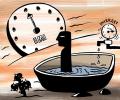
If banks cannot charge interest from borrowers during the moratorium, who will bear that cost? Should the depositors subsidise the borrowers by foregoing interest on deposits? In that case, we will turn banking on its head! notes Tamal Bandyopadhyay.

Like everything else, the structure of banks may change, and banks may depend more on digital technologies and artificial intelligence for dealing with both their customers and employees.

Even if they score administratively, state governments ruled by the party suffer from an inability to communicate positively, say observers.

It is time to take a few macroeconomic risks to kick start the growth.

'The Modi government must create conditions to integrate millions into the rural economy as many migrants are certainly not going to return to live an undignified life,' notes Ramesh Menon.

The GST Network's chairman Navin Kumar speaks to Dilasha Seth and Indivjal Dhasmana on various aspects of the new tax regime.

'The prospect is of a self-confident and self-sustaining India will make it a more effective player in the global arena,' External Affairs Minister Dr Subrahmanyam Jaishankar points out delivering the Sardar Patel Lecture-2020: India and the Post-Covid World.

These sectors have underperformed the wider market over the past year and are seen having far more upside potential if the economy picks up thanks to Modi's reformist agenda.

Following up on Finance Minister Arun Jaitley's Budget announcement of creating an integrated oil company, India's biggest oil and gas producer ONGC may buy all of the government's 51.11 per cent stake in Hindustan Petroleum Corporation Ltd.

Rebound in IT majors TCS and Infosys in late trades helped markets end higher.

Is it just the glamour?

Pranav Adani has come a long way since 1999, when he first got actively involved with the Adani Group's businesses, run by his uncle, Gautam Adani.
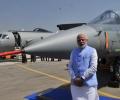
Prime Minister Narendra Modi promised a conducive environment for manufacturers, including a discrimination-free tax system

Exemptions, and the fact that farm income is outside the tax net, ensure that India's tax-GDP ratio stays low.
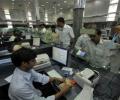
For the first time in our economic history a government has thought about more than 50 per cent of our economic activity instead of the five per cent represented by the Sensex companies, observes IIM-B professor R Vaidyanathan.

'The 24x7 power for all vision is inspiring, because as we've so often seen, where India leads, the world follows,' says Rajiv J Shah, President, The Rockefeller Foundation.

From the roll-out of GST to H1B visa problems, the government needs to quickly deal with various disruptions.

After the 2019 election, one thing is sure: GST will see a number of changes, explains Indivjal Dhasmana.

These companies had an accumulated loss of Rs 55,656 crore (Rs 556.56 billion) in 2012-13.

Among other things, taking note of complaints against several Chinese e-commerce players such as Shein, Ali Express etc for sending shipments as 'gifts' to customers in India and avoiding duties, the government has now mandated that all e-commerce sites and apps must have a registered business entity. This will be the importer on record and subject to customs rules, report Subhayan Chakraborty, Neha Alawadhi and Karan Choudhury.

Nikesh Arora is one of the highest-paid business leaders globally.
Or, what will the Indian policy process allow it to be, says Ajit Balakrishnan.

Besides providing a new source of employment, services like Uber are changing our mindset.

It is a national economic problem and one that requires a political solution hand in hand with a clear government commitment to stand behind core national assets, says Vinayak Chatterjee.

In the 2015 bypoll in the same RK Nagar seat, she had declared total assets of Rs 117.13 crore.

The revival of long-term growth is highly dependent on the revival of private investment.

'India is the largest stomping ground in the world for impact investing as we have an extraordinary combination of entrepreneurial drive with huge, absolute demand for all kinds of social services,' IDFC First Bank's chief Rajiv Lall tells Anjuli Bhargava.

'If the new rate is lower than your current rate, ask your bank to shift you to it.' 'This can be done by paying a fee of Rs 5,000 to Rs 6,000.'

On February 22, 2013, the Reserve Bank of India issued guidelines on 'Licensing of New Banks in the Private Sector'.

An asset swap can simultaneously boost public investment, reduce the fiscal deficit and keep fiscal policy from being pro-cyclical.
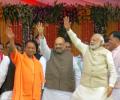
The BJP's manifesto for UP elections promised many things. But, given the state's precarious financial position, fulfilling these promises is likely to prove tricky, says Ishan Bakshi.

Common people expect the government to be aggressive and opt for growth related measures in the upcoming Budget.

Loan waivers will never be enough. Reforming the agricultural marketing system is essential to addressing the concerns of farmers in a sustainable manner, says Nitin Desai.
